











Type of Operating System
There are seven important types of Operating System. In this article we will discuss the seven most important types of operating system.
i) Batch Operating System
ii) Multi-Programming Operating System
iii) Time Sharing Operating System
iv) Multi-Processing Operating System
v) Distributed Operating System
vi) Network Operating System
vii) Real Time Operating System
1. Batch Operating System
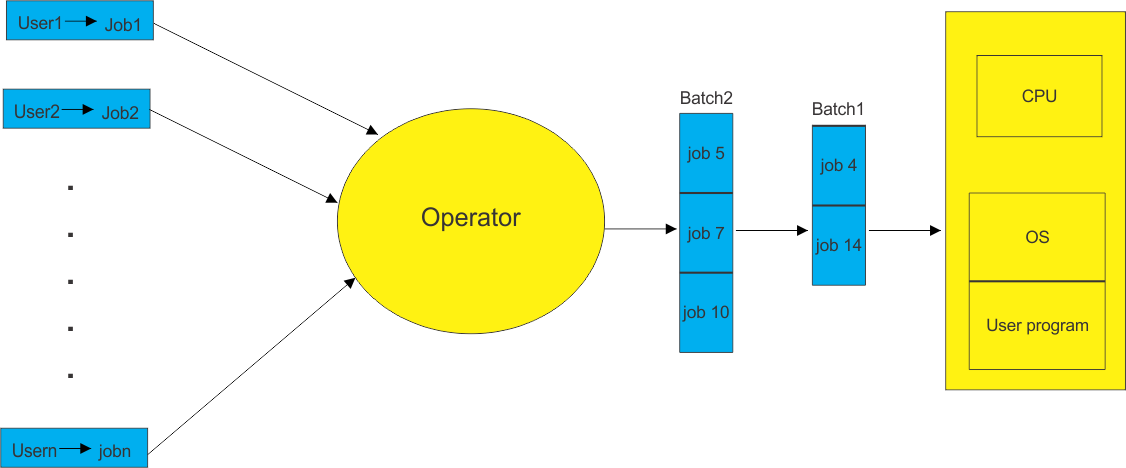
In batch operating system, jobs with similar needs are batched together and executed through the processor as a group. Operation sort jobs as a duck of punch codes into batch with similar needs such as FORTRAN batch, COBOL batch etc. Punch code means that in easy words we can say that a punched code stored information using holes made in a card or paper.
Advantages
i) In a batch job execute one often another saving them from activities like as a complier.
ii) During a batch execution no manual intervention is needed.
Disadvantages
i) Memory limitation
ii) Interaction of I\P and O\P device directly with CPU.
Examples
- Insurance Claim Processing
- Library Book Records
- Stock Market Reports
2. Multi-Programming Operating System
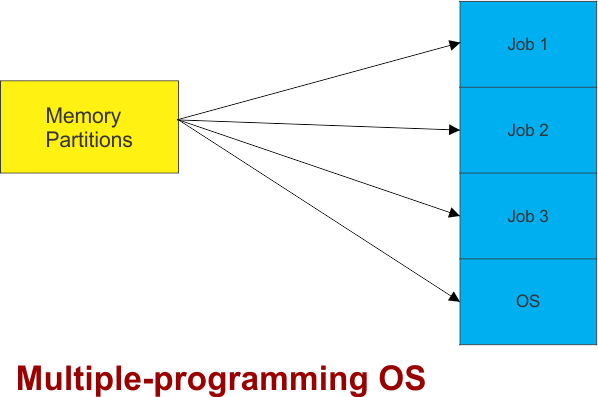
Multi-Programming Operating System also known as Non-Preemptive. In multi-programming operating system, for a time of process does I\O, the CPU can start the execution of other process. Multi-programming operating system is used a single CPU. Concept of context switching is used in multi-programming operating system. It simply switches and executes another job when current job needs to wait. It increase the CPU utilization.
Advantages
i) Increase CPU utilization
ii) User many experience faster response.
Disadvantages
i) The OS become more complex.
ii) Hardware cost and maintain cost is very high.
Examples
- Linux
- UNIX
- Windows
3. Time Sharing Operating System
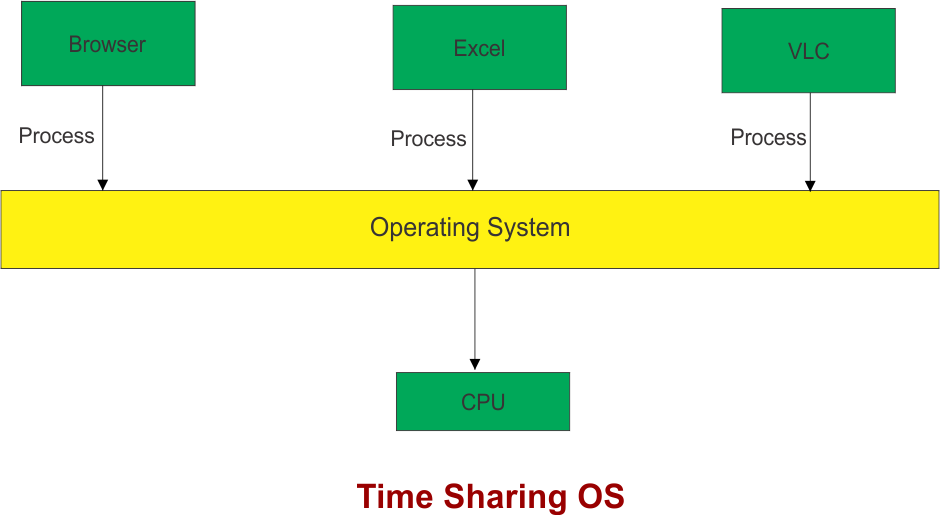
Time Sharing Operating System also known as Multitasking. In a time sharing operating system, each process is assigned some specific quantum of time for which a process is meant to execute. Time sharing operating system is used only a one CPU. Concept of context switching and time sharing are used in time sharing operating system. Switching happens when either allowed time expires or current processes needs to wait. It increase CPU utilization and also responsiveness.
Advantages
i) Reduce CPU idle time
ii) Each task gets an equal opportunity.
Disadvantages
i) The problem of data communication.
ii) Not fully reliable.
Example
- Linux
- UNIX
- Windows
4. Multi-Processing Operating System
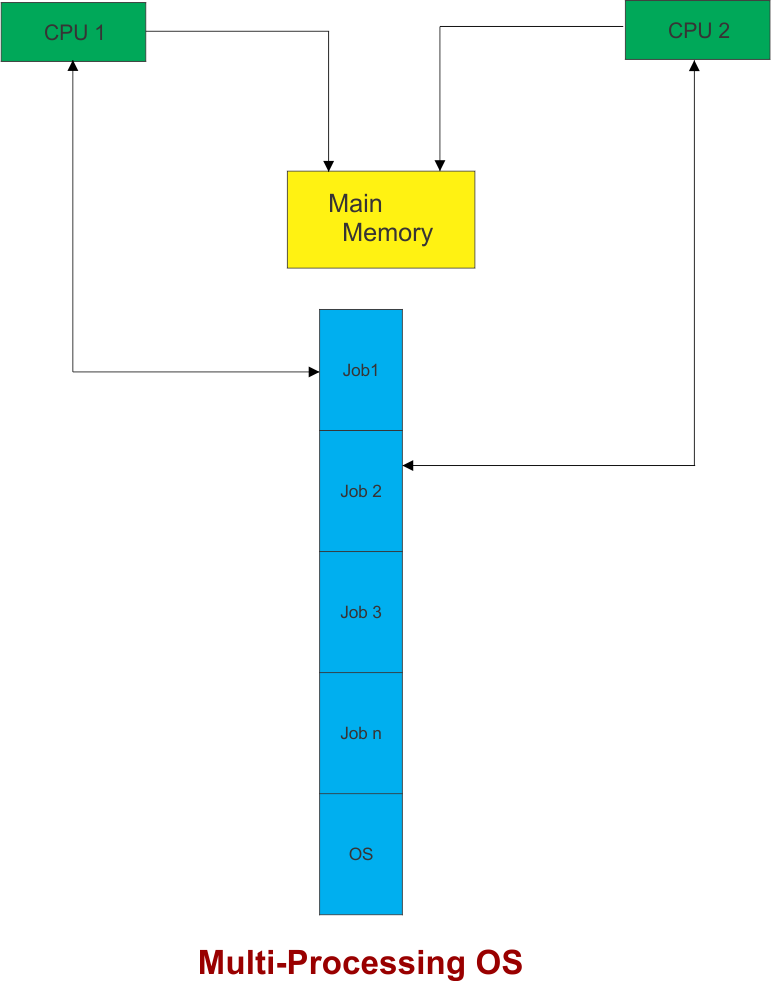
In Multi-Processing Operating System more than one processors present in the system which can execute more than one process at the same time. It means that which works on more than one CPU to improve performance.
Types of Multi-Processing Operating System
Two types of multi-processing operating system are given.
i) Symmetric Multiprocessor
One OS control all CPU, each CPU has equal rights. All the CPU are in peer to peer relationship.
ii) Asymmetric Multiprocessor
There is master process that gives instruction to all the other processors. It contains master-slave relationship.
Advantages
i) Max Throughput
ii) More Reliable System
iii) Fast Processing
iv) More Economic System
v) Efficiency Improved
Disadvantages
i) Complicated
ii) Large main memory required
Examples
- Android OS
- UNIX System
- Microsoft Windows
5. Distributed Operating System
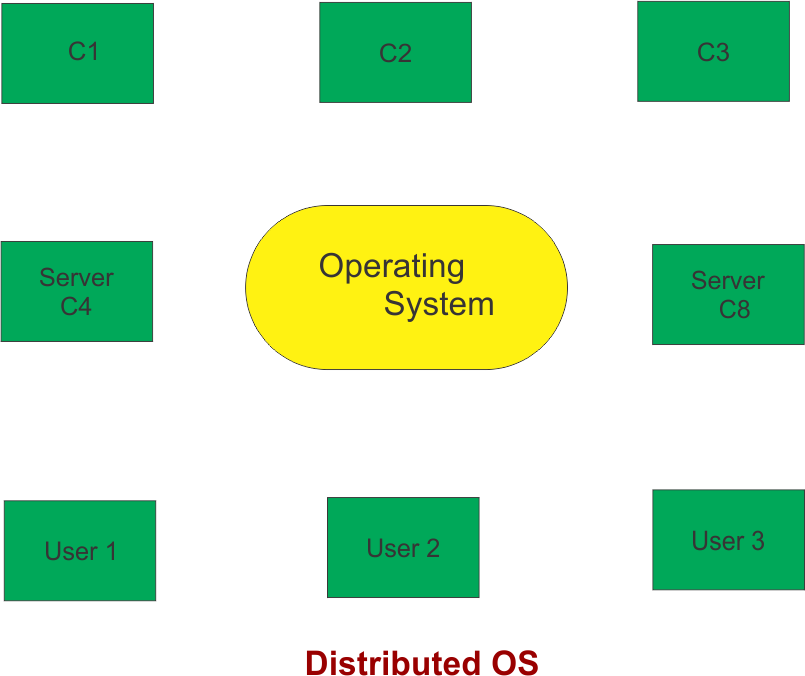
A distributed operating system is like a team of computer working together. It allow multiple computer to work together in coordinate manner to perform task and share resources mean such as file, data and processing power. Coordinate manner mean operating system. Two types of distributed operating system works. First is team work and second is also known as smooth operation. Team work mean multiple computers work together to share their power and resources. Smooth operation means that to user it feels like using a single computer, even through many are working behind the scene.
Advantages
Resources can easily share such as files data and processing power.
We can easily add more computer to increase performance and speed of performing operations.
Disadvantages
The design, development and management is very complex.
This OS is mainly depend on network.
Examples
- Amoeba
- Locus
- Chorus
6. Network Operating System
NOS stand for Network Operating System. It manage and coordinate a network of computers. It allow them to communicate and hare resources. It usually runs on server and provide server to manage and server can manage data, users, groups, security, applications and other networking function. Two important feature of NOS. First feature is file sharing and printer access and second one is user awareness. We use File Sharing and Printer Access in NOS to share a network and many computers can access the files and printer. User Awareness can aware the presence of multiple computer.
Types of NOS
Two types of Network Operating System (NOS) are as given.
i) Client Server Model
In client server model server provides services to clients. Client machine rely on server for accesing the services.
ii) Peer to Peer Model
In peer to peer model each computer acts as both server and clients. It provide the services to others and Vice Versa.
Advantages
Stability
Security
Scalability
Remote Access
Disadvantages
Cost
Dependency
Maintenance
Examples
- Microsoft Windows Server
- Windows NT
- UNIX
- Linux
- Mac OS X
7. Real Time Operating System
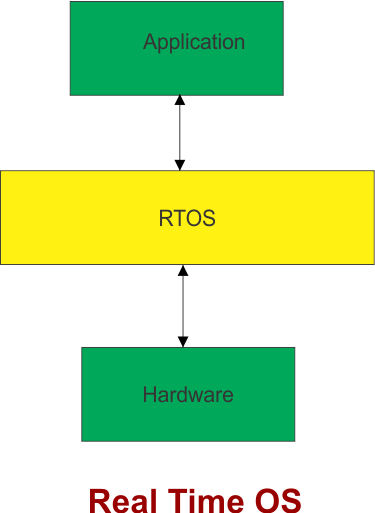
RTOS stand for Real Time Operating System. An RTOS is a software that helps the computer to done a task exactly when user needs without any delay. There are many important feature of RTOS such as quick response, very reliable and handles many task. Quick response mean it can respond super fast before a deadline. Very reliable mean it is work smoothly without crashing and handle many task mean it can manage multiple task at once. Traffic lights, drones and planes are use the TROS.
Advantages
It complete a task in limited period of time.
RTOS can handle many task without slowing down.
Disadvantages
Development of RTOS is very complex.
Development of RTOS is very high because it require high specification equipment.
Examples
- VxWorks
- Free RTOS
- RT Linux